Shopify pricing and fees in 2026: what WooCommerce owners really pay
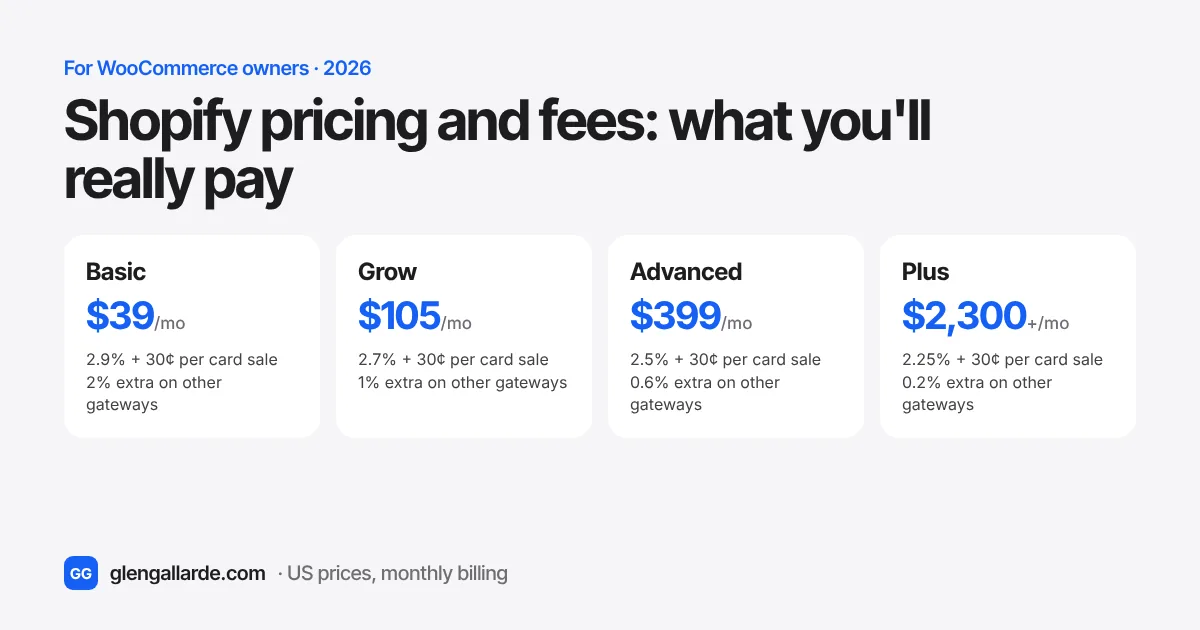
Shopify costs $39, $105 or $399 a month on its Basic, Grow and Advanced plans (about 25% less if you pay yearly), and Shopify Plus starts at $2,300. On top of that you pay a card fee on every sale, 2.9% + 30¢ on Basic in the US, plus apps. Use Shopify Payments and there's no extra transaction fee. Use another payment provider and Shopify adds 0.6% to 2% per sale.
If you run WooCommerce, you're used to costs that arrive as a dozen small bills: hosting, a theme licence, a few premium plugins, a security service, and the occasional developer invoice. Shopify bundles most of that into one monthly plan, then charges for the rest in a few new places that are easy to miss.
Most Shopify pricing articles list the plans and stop there. Some still quote last year's prices. This one is written for store owners comparing the two, and every number comes from Shopify's own pricing page and help center as of November 2026, US prices.
Shopify plans and prices in 2026
| Basic | Grow | Advanced | Plus | |
|---|---|---|---|---|
| Paid monthly | $39 | $105 | $399 | From $2,300 |
| Paid yearly (per month) | $29 | $79 | $299 | 1 or 3 year terms |
| Online card rate | 2.9% + 30¢ | 2.7% + 30¢ | 2.5% + 30¢ | 2.25% + 30¢ |
| In-person card rate | 2.6% + 10¢ | 2.5% + 10¢ | 2.4% + 10¢ | 2.3% + 10¢ |
| Extra fee with another payment provider | 2% | 1% | 0.6% | 0.2% |
| Staff accounts | Owner only | Up to 5 | Up to 15 | Unlimited |
Every plan includes hosting, an SSL certificate, unlimited products, Shopify's checkout, abandoned cart emails and selling in multiple countries with Shopify Markets. The plans mostly differ in card rates, staff accounts and reporting. You don't need a bigger plan to get a "proper" store.
Prices and rates change from time to time and vary by country. Check shopify.com/pricing for yours.
How much does Shopify take from each sale?
On the Basic plan with Shopify Payments, a US customer paying online by card costs you 2.9% + 30¢. On a $20 sale that's 88¢, so you keep $19.12. On a $100 sale it's $3.20.
That number moves depending on how the customer pays and how you've set up your store:
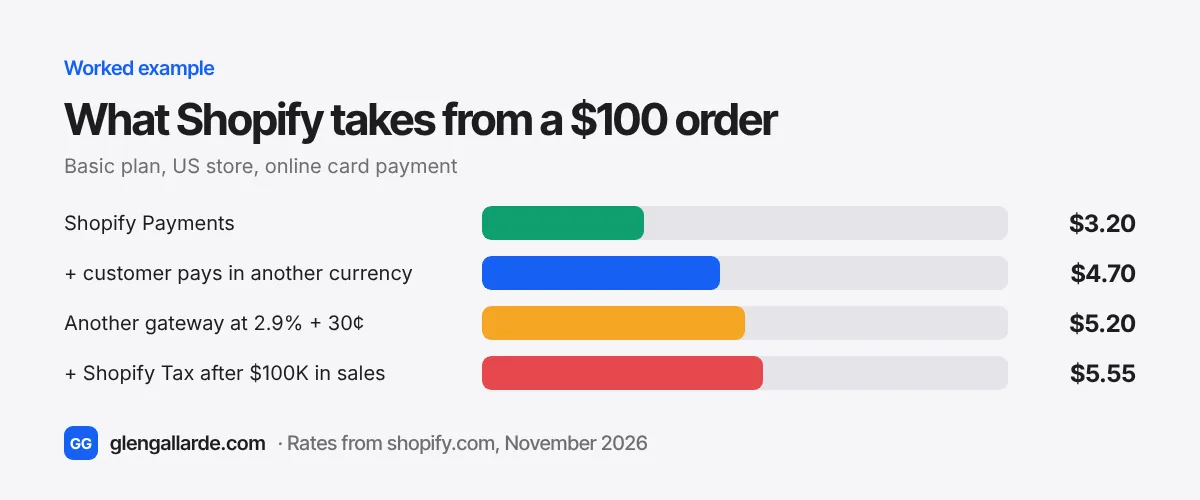
- Shopify Payments: $3.20. This is the baseline.
- Customer pays in their own currency: Shopify adds a 1.5% currency conversion fee for US stores, so $4.70. International cards can carry extra cross-border fees too.
- Another payment provider instead: say your provider charges 2.9% + 30¢ like before. Shopify adds its own 2% on Basic, so $5.20.
- Shopify Tax, once you pass the free threshold: another 0.35% on US orders, capped at 99¢ an order. That's 35¢ here.
For comparison, Stripe and WooPayments charge about the same 2.9% + 30¢ for US cards on WooCommerce. So card fees alone don't make Shopify more expensive. The extra gateway fee does, which brings us to the fee most WooCommerce owners don't know about.
Shopify's transaction fee, and how to avoid it
On WooCommerce, you pick any payment provider and pay only that provider's fee. On Shopify, if you use any provider other than Shopify Payments, Shopify charges an extra fee on every sale: 2% on Basic, 1% on Grow, 0.6% on Advanced and 0.2% on Plus.
It adds up fast. A store selling $20,000 a month through Stripe on the Basic plan pays Shopify an extra $400 a month for nothing. That's more than ten times the plan itself.
The fix is simple for most stores: use Shopify Payments. Apple Pay, Google Pay and Shop Pay all run through it, so customers still get the quick checkout options they expect. Shopify Payments isn't available in every country, and some products aren't allowed on it, so check both before you plan around it. If you can't use it, the extra fee belongs in your costs from day one.
The other fees on your Shopify bill
Apps
Apps are where Shopify bills grow. Many WooCommerce plugins you paid for once a year become Shopify apps you pay for every month, usually somewhere between $5 and $50 each. Reviews, subscriptions, product options and advanced filters are the usual ones. Five paid apps can cost more than the Basic plan. The free plugin to app finder shows which of your plugins need a paid app and which Shopify does for free.
Theme
Shopify's free themes are good, and plenty of stores never pay for one. Premium themes are a one-off payment, usually a few hundred dollars, with updates included.
Shopify Tax
Shopify can work out sales tax for you. It's free up to $100,000 in sales, then costs 0.35% per US order (0.25% in the EU, UK and Canada), capped at 99¢ an order. One detail matters if you're migrating: for stores created on or after 13 May 2026, that $100,000 is a lifetime total, not a yearly one. A store moving from WooCommerce now is a new Shopify store, so a store doing $250,000 a year passes the free allowance in about five months and pays it from then on.
Currency conversion
Sell in your customers' currencies with Shopify Markets and US stores pay a 1.5% conversion fee on those orders. It's usually worth it, because shoppers buy more when prices are in their own currency, but count it.
Domain and email
You don't need to buy a new domain. Keep the one you have at your current registrar and point it at Shopify. Your email marketing tool, like Klaviyo or Mailchimp, also stays the same price wherever your store lives.
Which Shopify plan should you pick?
Start on Basic unless you need more than one staff login. Moving up a plan only saves money once the lower card rate covers the higher plan price. Each step up cuts the card rate by 0.2 percentage points, so the break-even points are easy to work out:
| Upgrade | Pays for itself above (monthly billing) | Pays for itself above (yearly billing) |
|---|---|---|
| Basic to Grow | About $33,000 a month in card sales | About $25,000 a month |
| Grow to Advanced | About $147,000 a month | About $110,000 a month |
There are other reasons to move up: Grow gives you 5 staff accounts, and Advanced gives you 15 and more detailed reporting. But if you're the only one in the admin and selling less than $25,000 a month, Basic is the right plan. I see a lot of stores paying for Grow because it sounded more serious.
What about Shopify Plus? At $2,300 a month and up, it makes sense for stores with high volume, wholesale needs or a lot of checkout customisation. Most WooCommerce stores I audit aren't there. If you're wondering, the WooCommerce vs Shopify comparison covers when the bigger plans earn their keep.
What you stop paying when you leave WooCommerce
This is the half of the comparison most Shopify pricing guides leave out. Moving doesn't just add a Shopify bill. It removes several others:
| WooCommerce cost | On Shopify |
|---|---|
| Hosting | Gone. Included in the plan. |
| SSL, CDN and backups | Gone. Included. |
| Security plugin or service | Gone. Shopify runs the servers and patches them. |
| Premium plugin licences | Some disappear (Shopify does it), some become monthly apps |
| Theme licence | Free theme, or a one-off payment |
| Developer time for updates and fixes | Mostly gone. No core, theme or plugin updates to manage. |
| Card fees | About the same with Shopify Payments |
| Domain, email marketing tool | Unchanged |
A monthly example: $20,000 in sales
Here's a typical small store: $20,000 a month in online sales, 250 orders averaging $80, all US cards. The WooCommerce side uses common costs I see in audits. Your numbers will differ, which is why the assumptions are shown.
| Monthly cost | WooCommerce | Shopify Basic |
|---|---|---|
| Hosting or plan | $50 managed hosting | $39 |
| Plugins or apps | $40 (yearly licences, spread out) | $60 (three paid apps) |
| Security and backups | $15 | $0 |
| Developer upkeep | $150 (averaged over the year) | $0 |
| Card fees at 2.9% + 30¢ | $655 (Stripe) | $655 (Shopify Payments) |
| Total | $910 | $754 |
Two things would flip this. If the same store kept Stripe on Shopify, the 2% extra fee would add $400 and make Shopify the expensive option. And if your WooCommerce store rarely needs a developer, the gap shrinks to almost nothing. To run it with your own numbers, use the free WooCommerce vs Shopify cost calculator.
Ways to pay less on Shopify
- Pay yearly. It cuts the plan price by about 25%, from $39 to $29 a month on Basic.
- Use Shopify Payments. It removes the 0.6% to 2% extra fee completely.
- Stay on Basic until your sales pass the break-even point above.
- Check your apps every few months. Uninstall the ones you don't use, and look for apps that do two jobs.
- Start with a free theme. Shopify's free themes are fast, and you can buy a premium one later if you need it.
- Keep your domain where it is. There's no need to move it or pay twice.
Questions
How much does Shopify cost per month?
$39 on Basic, $105 on Grow and $399 on Advanced when billed monthly, or $29, $79 and $299 a month when billed yearly. Shopify Plus starts at $2,300 a month. Most stores also pay $20 to $100 a month for apps.
How much does Shopify take from a $20 sale?
On the Basic plan with Shopify Payments, 2.9% + 30¢ for a US online card payment, which is 88¢. You keep $19.12. With another payment provider, add Shopify's 2% fee (40¢) on top of that provider's own charge.
Does Shopify charge transaction fees?
Only if you use a payment provider other than Shopify Payments. Then it's 2% on Basic, 1% on Grow, 0.6% on Advanced and 0.2% on Plus, on top of the provider's fee. With Shopify Payments you pay the card rate only.
Is Shopify more expensive than WooCommerce?
The plan is a cost WooCommerce doesn't have, but WooCommerce has hosting, security, premium plugins and developer time that Shopify mostly removes. For many small stores the totals end up close, and Shopify often comes out cheaper once upkeep is counted. The cost calculator shows it for your store.
Is there a free trial?
At the time of writing, Shopify offers 3 days free, then $1 a month for your first 3 months on select plans. If you're migrating, the trial period is a good time to build and test before your store goes live.
What does it cost to move my WooCommerce store to Shopify?
An app costs $60 to $800 for the data alone. A fixed-price migration with me starts at $1,495, and agencies usually charge $5,000 or more. The migration cost guide compares every option.